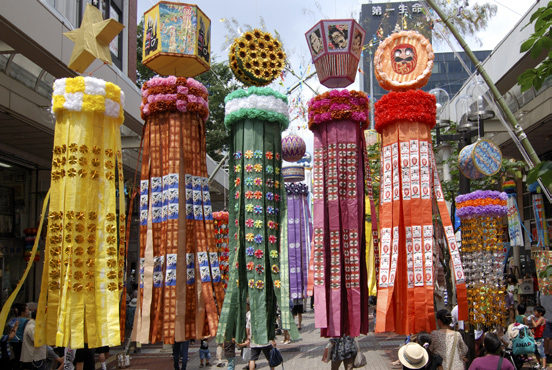
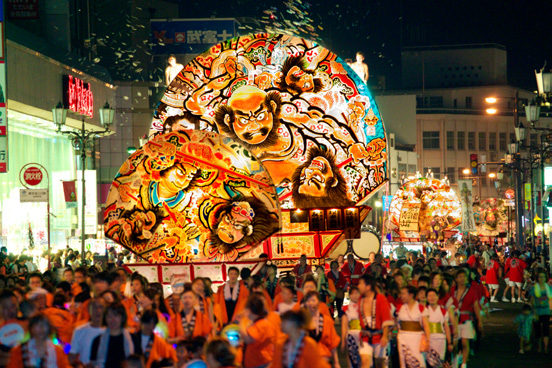
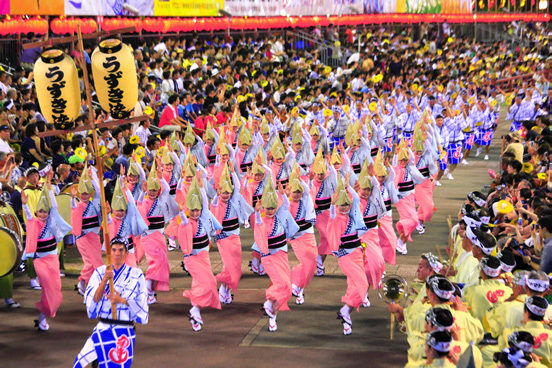
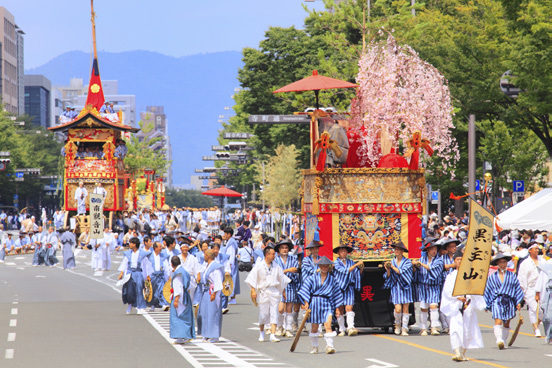
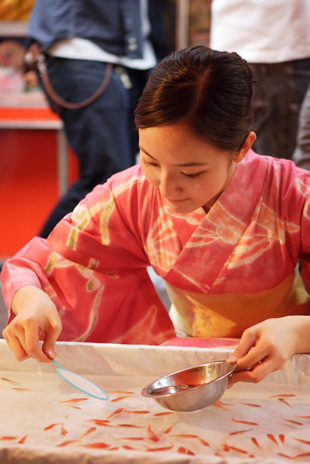
七夕祭り(仙台)Tanabata Festival (Sendai)ねぶた祭り(青森)Nebuta Festival (Aomori)阿波踊り(徳島)Awa Odori Festival (Tokushima)祇園祭(京都)Gion Festival (Kyoto)金魚すくいGoldfish scoopingチョコバナナChocolate banana
Summer festivals are held everywhere in Japan from around July to August. Tourists from all parts of Japan visit famous festivals. Some examples are Aomori's Nebuta Festival, Sendai's Tanabata Festival, Kyoto's Gion Festival, and Tokushima's Awa Odori Festival.
Many different stalls are set up during a summer festival. For example, there are food stalls selling yakisoba and okonomiyaki, sweets stalls selling cotton candy and chocolate bananas, toy stalls selling masks, etc., and game stalls such as shooting galleries and goldfish scooping. Some festivals also have Bon festival dances and fireworks displays. You should try to go to a festival in your neighborhood.
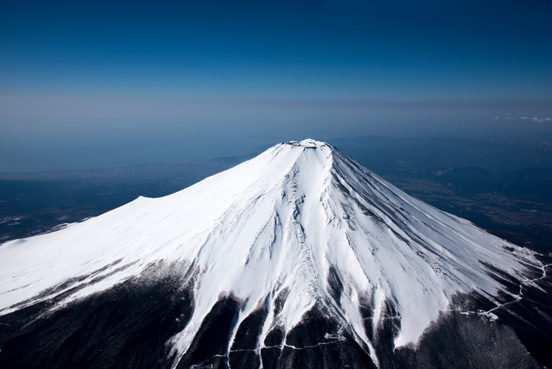
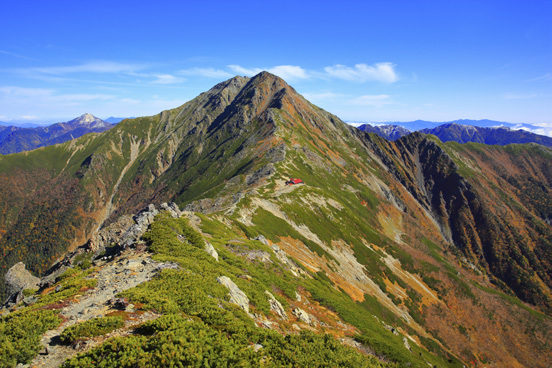
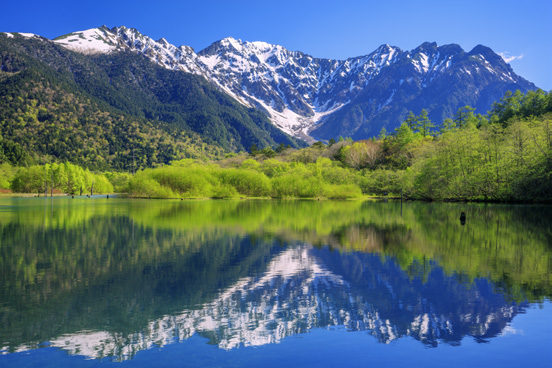
70% of Japan's territory is made up of mountains, and Japan is very mountainous. Japan has high mountain ranges running across it like the backbone of the country. The high mountain range that stretches from Toyama Prefecture to Shizuoka Prefecture is called the Japanese Alps. It cuts across Nagano Prefecture and Gifu Prefecture. It is divided into the Northern Alps, Central Alps, and Southern Alps.
You do not need to be an experienced mountaineer with expert equipment to climb most mountains in Japan. During the climbing season in summer, even regular people can climb the Japanese Alps, although they will need certain equipment. (However, inexperienced climbers should go with a guide.)
There are also many mountains just outside the city that are easier to climb. It is possible to climb some of these on a day trip, such as Mt. Takao and Mt. Tsukuba in the Kanto region, and Mt. Rokko in the Kansai region, so they are very popular as hiking destinations.
Many Japanese mountains are also volcanic. This is why there are hot springs on or at the foot of the mountains. One of the best things about mountaineering or hiking in Japan is that you can soak in a hot spring at the bottom of the mountain afterwards, and relax after the tough climb.
In the film series Otoko wa Tsurai yo (meaning "It's tough being a man"), actor Atsumi Kiyoshi plays the leading character, Kuruma Torajiro (nicknamed Tora-san). The film was written and directed by Yamada Yoji. There are 50 films in total, from the first film released in 1969 (Otoko wa Tsurai yo) to the 2019 release (Otoko wa Tsurai yo – Okaeri Tora-san). It holds the Guinness World Record as the longest-running film series. Until 1995, one film was produced and released almost every year. The series ended in 1996 with the death of Atsumi. The 50th film was produced in 2019 on the 50th anniversary of the series.
The main character, Tora-san, was born in Shibamata, a downtown area of Tokyo. He works as a travelling salesman. Tora-san is somewhat eccentric and unconventional. He fights with his family in Shibamata, and causes problems with various people he meets on his trips. The films follow a general pattern. Tora-san usually falls in love with a girl but is rejected at the end. Although the films are a little old, they show various elements of Japanese life, such as Japanese people's sense of social duty, their emotions, and romance. Watching a film about Tora-san might be a chance to think more deeply about Japan and the Japanese people.
The Otoko wa Tsurai yo series is available on streaming services for free if you register as a user. There are also websites where you can rent it cheaply.
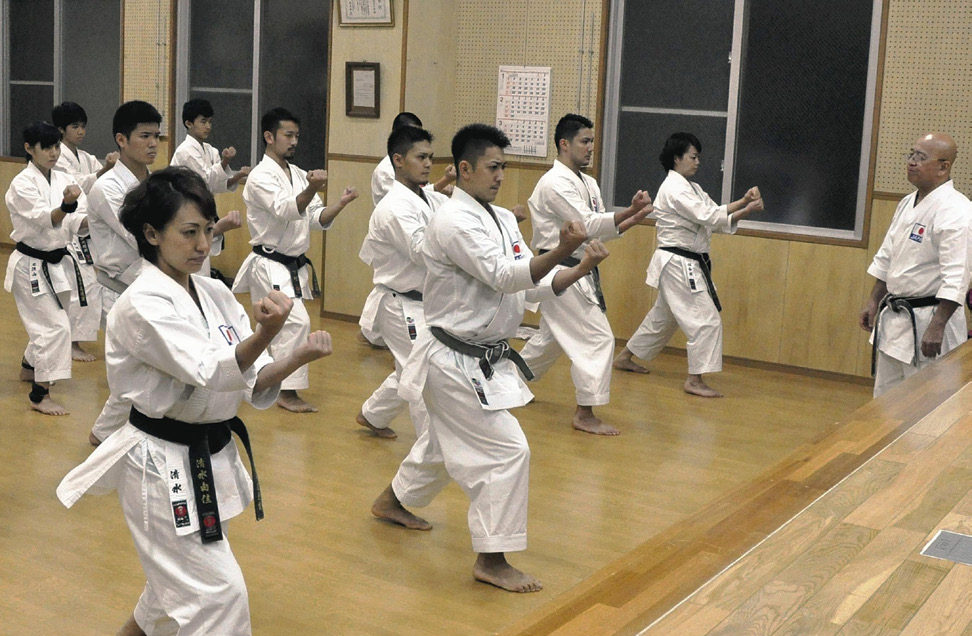
Karate is a Japanese martial art from Okinawa. Unlike judo and aikido, the main form of attack is by striking the opponent, such as by punching or kicking them.
Today, there are various styles of karate. Traditional styles of karate follow the rule of sundome (stopping just before actually hitting someone). Based on this rule, you do not hit the opponent directly in a match. They also emphasize kata (form), in which one person performs a series of set moves in order. There are four main styles, which are Shotokan, Wado-ryu, Shito-ryu, and Goju-ryu.
There are also styles where the rule is to strike the opponent in a match. This is full-contact karate. Depending on the style, participants may or may not wear protective equipment and gloves, and may or may not hit the opponent's face. Some full-contact karate athletes even participate in strike-based mixed martial arts competitions. Kyokushin karate is a full-contact style of karate. It is becoming quite popular around the world.
If you want to learn karate in Japan, you should be able to find a local karate gym easily just by searching online. Make sure to check the details carefully before you go because the traditional and full-contact styles are very different, as explained above.