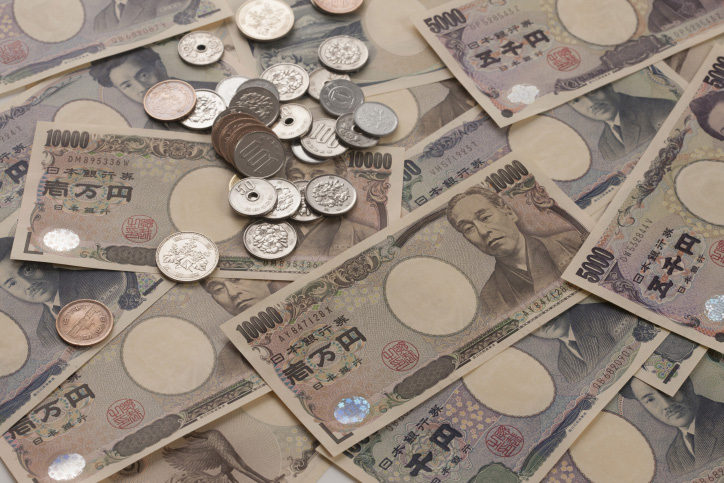
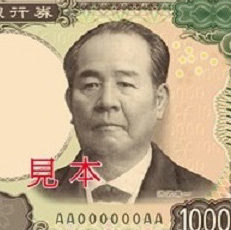
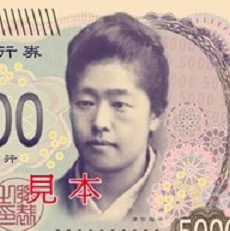
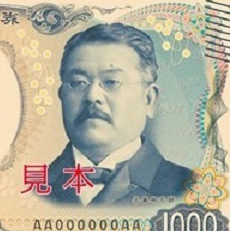
The types of money that are used in Japan now are: Bills: 10,000-yen bill, 5,000-yen bill, 2,000-yen bill, and 1,000-yen bill Coins: 500-yen coin, 100-yen coin, 50-yen coin, 10-yen coin, 5-yen coin, and 1-yen coin
The government has announced that new bills will be issued in 2024. The new bills will have features such as 3D holograms. The bills show people from history. Here are the people who are featured on the bills in 2020.
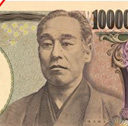
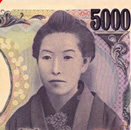
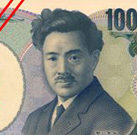
10,000-yen bill: Fukuzawa Yukichi (1834-1901) = Educator, scholar. Founder of Keio University. Author of Gakumon no Susume (An Encouragement of Learning), which is well-known for the quote "Heaven does not create one man above or below another man." 5,000-yen bill: Higuchi Ichiyo (1872-1896) = Writer, poet. Author of novels such as Takekurabe (Growing Up) and Nigorie (Troubled Waters). 1,000-yen bill: Noguchi Hideyo (1876-1928) = Doctor, bacteriologist. Did important research on yellow fever, syphilis, etc.
10,000-yen bill: Shibusawa Eiichi (1840-1931) = Industrialist known as the father of modern Japanese capitalism. Founder of Japan's first bank. 5,000-yen bill: Tsuda Umeko (1864-1929) = Founder of Tsuda University. Pioneer of women's education in Japan. 1,000-yen bill: Kitasato Shibasaburo (1853-1931) = Medical scientist who discovered the bacteria that caused plague, and developed a treatment for tetanus.
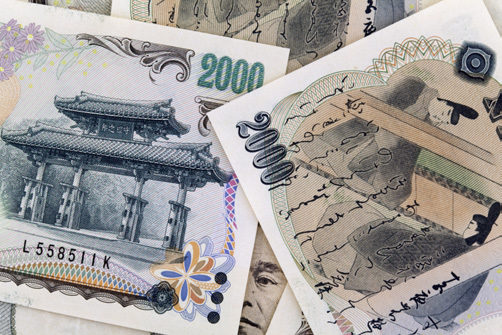
The 2,000-yen bill is rarely used in everyday life. The 2,000-yen bill was issued to celebrate the Okinawa Summit in 2000. The design shows the Shureimon of Shuri Castle in Okinawa. However, it was not used widely because it was often not accepted by vending machines. These days, it is sometimes seen in Okinawa but almost never seen in other parts of Japan.
The 5-yen coin and 50-yen coin have a hole in the center. As this is unusual when compared with other coins around the world, some foreign tourists keep these coins as souvenirs. The 5-yen coin is said to bring good luck because it is pronounced as go-en in Japanese. This sounds the same as the Japanese word ご縁 for fate or chance. For this reason, people often offer the 5-yen coin to shrines. The 5-yen coin is also the only coin that does not have an Arabic numeral written on it. It only has the kanji characters for five yen written on both the front and back.
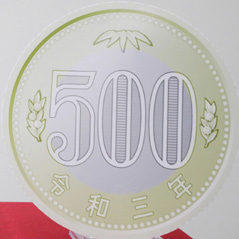
The 5-yen and 1-yen coins are not accepted by vending machines. If you try to force them into the machine, you may damage the machine, so don't do it. The 500-yen coin will also be updated in 2021 to become a two-colored coin.
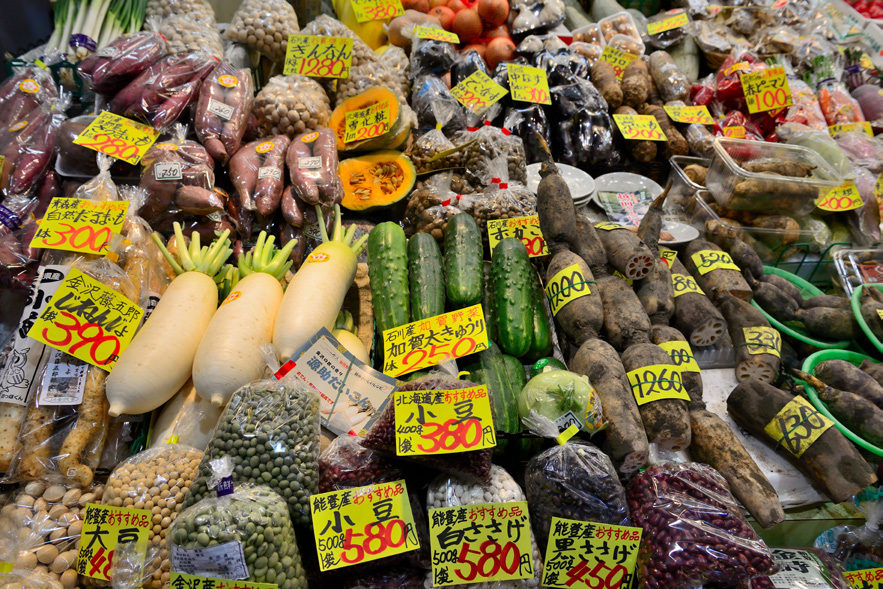
When you are shopping in your country, do you have to ask for the price? If you are buying something in a shop in Japan, the price will be shown most of the time. Usually, if you look closely at a product, you will find a price tag on it. You may also find the price shown on the display shelf. It is not common to negotiate the prices and ask for a discount, except at electronics stores.
However, as shown in the main text, there are also places where the prices of products are often not shown, or where the price tags or displays are difficult to find. Some examples are flea markets, when buying directly from farmers, and at shops run by private owners.
If you ask for the price but do not understand the answer, you can ask the staff to write it down for you or type it out for you on a smartphone calculator.
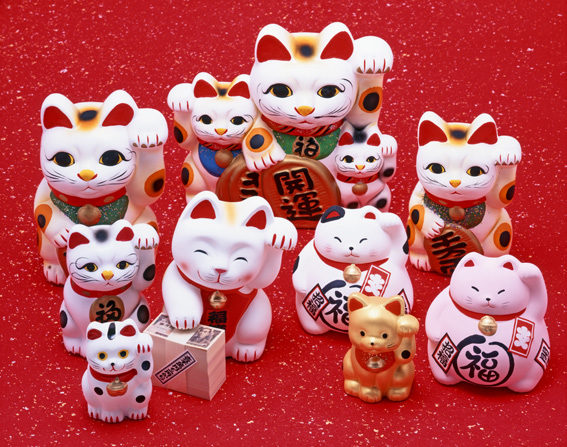
A maneki-neko (a lucky cat) is a figure of a cat with one raised paw. Its front paw is raised in a beckoning gesture. So, people believe that it will bring good fortune, or bring many customers into a shop. Because of this, it is sometimes given to people as a good-luck present, especially to congratulate someone on opening a shop. Small maneki-neko are also a very popular Japanese souvenir among foreign tourists, because they are a lucky charm and cute.
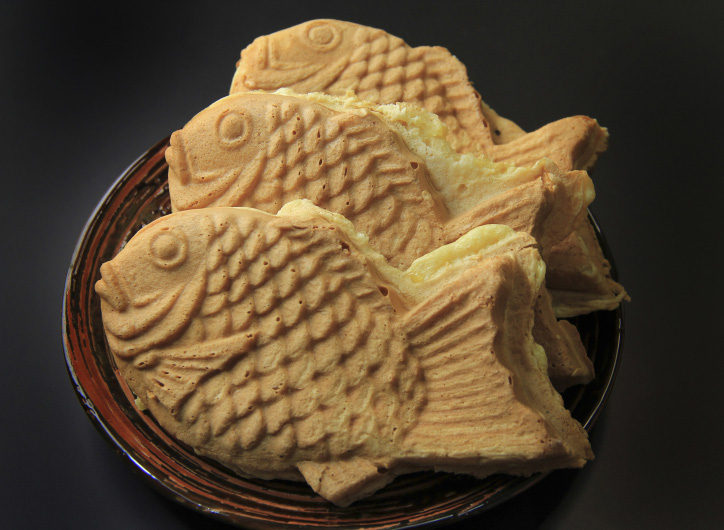
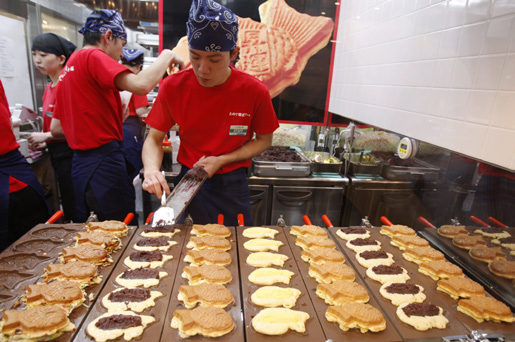
Taiyaki is a grilled snack made of wheat flour dough and filled with sweet bean paste. It is grilled in a metallic frame shaped like a sea bream. It looks like a sea bream so it is called taiyaki (grilled sea bream). Traditional taiyaki is filled with sweet bean paste. Recently, taiyaki with other fillings such as chocolate and custard cream are also available.
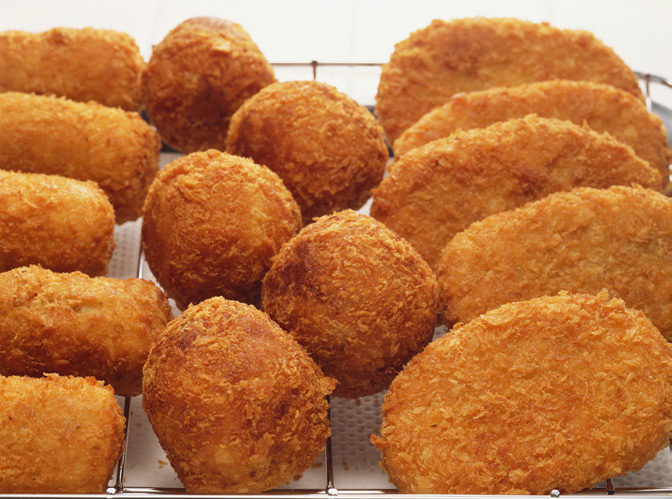
Korokke is made by boiling and mashing potatoes, and mixing the potatoes with minced meat and onions. This mixture is then coated with breadcrumbs and deep-fried in oil. There is also cream korokke made with Japanese white sauce or bechamel sauce, instead of potatoes. It is said that the European dish croquette was introduced to Japan during the Meiji era and this turned into the korokke in Japan today.
You can buy korokke cheaply at the ready-made food section in supermarkets, and the section for deep-fried food at the butchers. You can buy it as a convenient side dish for your meal. It is also sold as a frozen food, and is a popular dish to include in meal boxes.
A similar food that is made with minced meat, without any potatoes, is known as menchi-katsu. Menchi-katsu is often sold together with korokke. This is a popular side dish too. Korokke and menchi-katsu are usually served with soosu (a black, Japanese-style sweet and savory sauce).
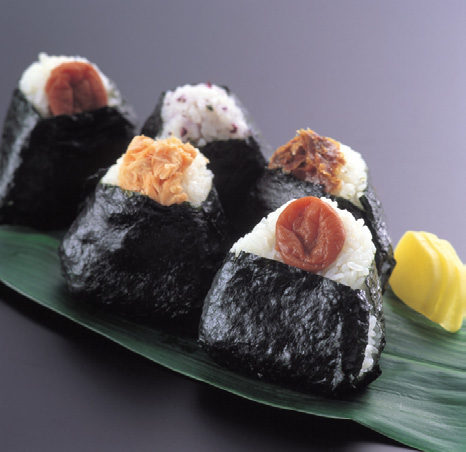
Onigiri (rice balls) are made by adding ingredients to rice. The rice with ingredients inside is shaped into triangles, and wrapped with grilled seaweed. Onigiri are sometimes also called omusubi. Depending on the region, they may be made into a barrel shape instead of triangles. An onigiri can be made with steamed rice with red beans or rice cooked with various ingredients, instead of white rice. In these cases, it is sometimes not wrapped with grilled seaweed.
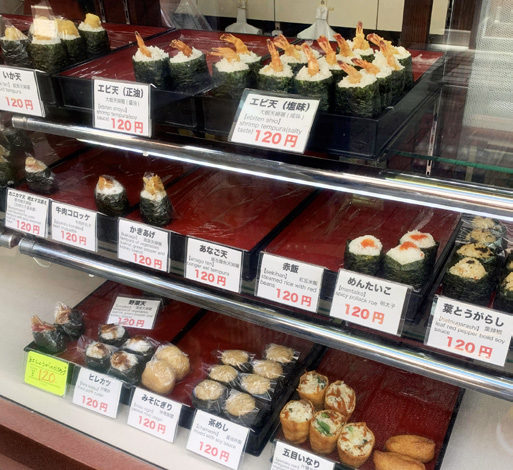
A wide range of onigiri is also available at convenience stores. Some are simple with fillings such as plum, kelp, salmon, cod roe, or tuna. Others are fancy, such as beef sukiyaki or salmon roe pickled with soy sauce. There are also onigiri specialty stores with showcases that are full of many different types of onigiri. As described in the main text, when buying onigiri from a specialty store, you have to tell the staff which onigiri you want and how many you want to buy.
Onigiri is also simple to make on your own. Places like the 100-yen shop and supermarkets also sell frames for making onigiri. You can use them to make onigiri easily without trying to shape them with your own hands.
Cash has been the main payment method in Japan for a long time. Compared to other countries, cashless payment methods are not often used in Japan. Many regular shops accept only cash and not credit card. Some people say this is because it is not very dangerous to walk around with cash in Japan. Also, there is hardly any fake money.
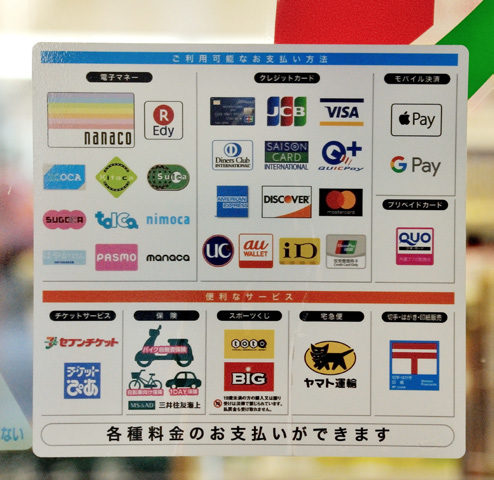
However, use of cashless payment methods has finally been increasing recently. In addition to credit cards, electronic payments have also become more common. Here are some of the types of electronic payments.
Prepaid transportation cards were originally designed for paying fares by tapping them at the ticket gate, so that you can take trains or buses without buying a ticket. However, they are becoming a popular form of electronic payment for daily use. This is because they can be widely used not only for transportation, but also at places like convenience stores and shops. When you pay for something with a prepaid transportation card, tap it on the device at the checkout counter. Some examples are Suica, ICOCA, and PASMO.
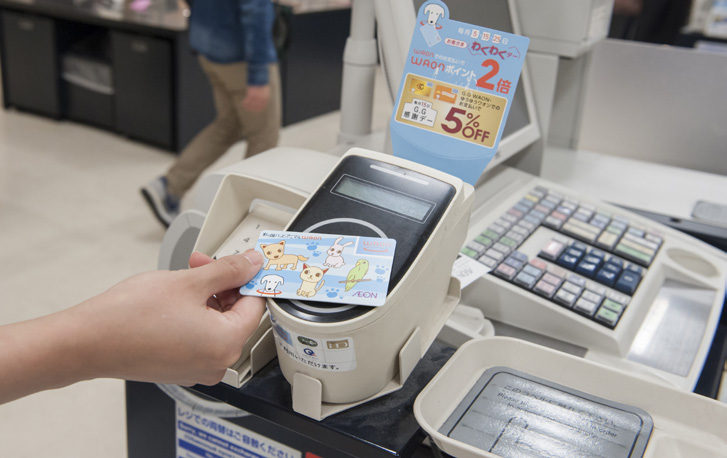
These are electronic payment cards for shopping at supermarkets and convenience stores. Some examples are Rakuten Edy, WAON and nanaco. Similarly, to pay with a prepaid shopping card, tap it on the device at the checkout counter.
This is an electronic payment app. When you pay for something, you scan a QR code in the shop using a smartphone app. Some examples are PayPay and LINE Pay. When paying at a convenience store, you show a barcode on your smartphone app. The staff then scans this barcode using a device at the checkout counter.
Currently (2020), there are very many types of electronic payment services in Japan, offered by various companies. However, even now, many stores still only accept cash, especially outside big cities. In Japan, it is better to always carry some cash around with you.